
Poison ads
From practice to theory
Introduction
An ad and what's wrong with it
How to treat nonlinearity
Free Will
References
Introduction
Memes exist everywhere. From the mind of an individual, to groups and organisations, to societies and to the global human population (now they can occur in the form of a group mind), our behaviour is driven by the ideas we accumulate inside our heads.
Some can be readily identified as positive, some as negative, and there are some that have a more insidious influence. Although not directly seen as destructive, they can nevertheless configure the way we build our thoughts. Here we are dealing with the latter.
That education is not only about imparting information per se but also teaches us how to think is hardly worth debating. It is the logical, sequential addition of data that makes for the coherent concept, the principle of which can be made use of later on. If the conceptual elements are not logical, the result will be a form of misunderstanding or no understanding at all. As we learn to apply logic in one area it becomes more habitual to practice it in others.
We import information all the time, however unwittingly. One significant source is advertising - it surrounds us every day. What if ads contain inherent inconsistencies that impact on our way of thinking?
That's what this article is about. First a walk-through of an ad, followed by a few remarks about the type of system we are dealing with. With that perspective in mind, addressing the question of Free Will becomes more productive.
 An ad and what's wrong with it

On the right is an example of common advertising [1]. It seems innocuous and no doubt attracts many responses. Note the text "BE THE FIRST TO KNOW".
Really? Readers are prompted to download an app that is linked to its server and as soon as some news break makes them appear on their screens. It doesn't matter how many thousands of users there are, they all receive the alert at the same time; no individual is therefore going to be "the first". Still, the message is attractive and won't disappoint. On the other hand ...
The resultant meme "I'll be the first" is clearly incorrect, but hardly anyone will give it a second thought. However, from now on there will be one notion residing within the person's mind that is not logical, yet is accepted out of sheer convenience.
The secondary meme can form an abstraction in terms of its own illogicality which only needs some affinitive other to be accentuated at that level. As such it easily multiplies, provided there are more ads constructed in a similarly illogical fashion. (And how about a pricing like 29.99?) As we absorb these types of messages over and over again, we get used to think along those lines. In other words, we have learned not to bother with the jarring detail and by doing so suppress our mental defences against the irrational.
If all that sounds too trivial, consider the not uncommon phenomenon of provocation, especially the smaller kind, the one we usually don't bother with at the time. A little criticism here and there, if repeated over and over again, may well cause the recipient to explode eventually. It doesn't matter whether the remarks were applied to a different content each time, they all add up. What the recipient reacts to is the abstracted version going beyond the specifics; the abstracted version being representative of the criticism as such. Then the meme "I'm constantly being criticised" makes itself felt on so many more occasions.
When it comes to the influence advertising wields, the effects of products coming into fashion due to their widening awareness confirms the ease with which imitation sways the market. Thought structures do not operate in terms of a specific, linear detail. Rather, what matters are the innumerous relationships that the contextual clusters have formed with each other, and thereby in turn lead to the formation of an overall mindset. Whether those clusters can be seen as positive or aggressive, as benign or malicious, they all combine to create the overall whole.
Technically speaking, incoherent thoughts lead to yet another type of abstraction. Then, being of the abstractive kind, they influence other content in a similar manner.
Another example would be the attraction towards a performer on stage. There can be hundreds, if not thousands, of ardent followers swaying to the music, sometimes enraptured to the point of delirium. Given the many options available to everyone during any given day, it would be rather disingenuous to assume that everybody at that rock concert had suddenly and simultaneously got the idea to attend on this particular day (or crowds showing up at a demonstration for that matter). There obviously would have been the announced date, but the underlying reason for their presence was the planted insinuation of a meme complex directing their holder towards the psychological embrace.
For the performer there would be the time of struggle at first, when the memetic anchor points are assembled from ground up, with only a few derived from the ambience of some suburban joint. The breakthrough happens when an agent deems it worthwhile to bother and that's where the real meme construction begins. The result is the big stage. Note the role affinity plays: There needs to be a certain willingness in the recipient's mind, but without the abstractive properties of correlated memes the big wave won't happen.
The same goes for native dress codes. How many ways are there to dress? Yet the members of that demographic have all chosen the same one. Even if the climate would suggest otherwise, the woman wraps herself in the clothes dictated by her religion and/or culture. The pressure may exist at first in the form of daily emotional coercion if not beatings, but from her teenage years onwards there is no longer the need for compulsion; she can be relied upon to follow the dogma even to the point of actively resisting freedom.
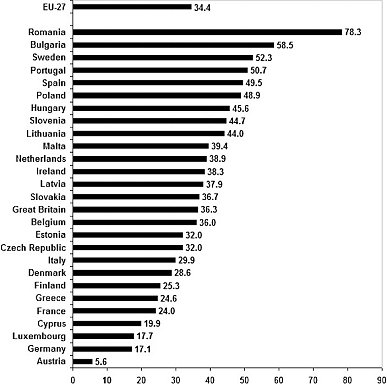
Support for Turkish membership in the EU 2011 [3]
In general, we circumscribe by the word 'meaning' the associations we apply to something as they well up, the representative content of those abstraction complexes formed over time. The greater the capacity for abstractions combined with the additional information, the more comprehensive the meaning we attach to whatever is under focus. That's why to a historian a building can be far more meaningful than to someone who only sees the thing itself. The same goes for the less tangible, such as a story read by a child compared to an adult. A child crying at a funeral does not display the same mindset as an older person who is deeply moved by the passing of someone with all their attributes collected over the years. Perhaps the child won't cry at all and not because they are heartless.
On a large scale the group mind can contain elements of a cultural memory, events that were so dramatic they are recalled generation after generation no matter what happened since.
In 1529 and 1683 Vienna was besieged by the Ottoman Empire [2]. Neither attack was successful, but during the months-long sieges life in the city was terrible. Ever since those events have been remembered. Is it pure coincidence that today, with all the contemporary factors in place, the greatest opposition to (now) Turkey's accession to the European Union nevertheless comes from Austria? [3].
Today, social media create their own memes. They can be so powerful, they are answered to even if their prompt results in killing. The detail may involve one or the other individual, but once abstracted the idea gets applied to no one in particular.
Note the nondiscriminatory nature of those affinity relationships. What matters are the characteristics of the functional elements being attracted to others of a similar kind. When politicians for example express themselves in uncivilised ways, they not only push their memes towards their opponents, the aggressive ambience they have created will affect everyone, including themselves. The old adage "live by the sword, die by the sword" captures the situation rather well.
Political strategists are a prime source of meme creation, especially during election time. For them the focus is on attracting as many citizens as possible to a concept for which affinities are devised which in turn are meant to enable the voter to connect their own disposition with that of the party. At that level of operation the concrete mechanics of society, such as taxes, infrastructure, health services and the like, are of secondary importance. What matters is their appearance in the mind of constituents. The appearance is the packaging. And, just as undoing the wrapping of a present may lead to disappointment if the actual content is not what was expected, what eventuates after the election forms the ambience of disenchantment within the population. An ambience that creates its own memes being applied to the material content of daily life.
The longer such a process continues, the wider the range of aversion and the more accentuated its elements and their respective influence. The dynamics progress from there under the same auspices. The result is more disaffected citizens and an increasing number of causes. Life has become a stack of empty shells. Sounds familiar?
So much for the practice. Here's the theory: Every action imported into the mind creates its own abstract version which from then on influences other affinitive notions.
It would be worthwhile to examine human culture in terms of such a potential.
How to treat nonlinearity
Nature is nonlinear but the awareness of it only emerged during the last century. Its full understanding is still lacking in many quarters.
The ignorance manifests in the way rigorous scientific reasoning is meant to function. If the task is to establish a correlation and/or causation between an overall system and one of its parts the accepted way would be -
• define the overall scope of the system to be dealt with;
• within that scope, focus on one member, the candidate for analysis;
• define that member's characteristics;
• examine every other member of that system in terms of those characteristics;
• do the rest exhibit the characteristics?
• if so, there is a correlation etc between the overall system and its member;
• if not, the claim cannot be made.
The process is valid in the case of a linear system. However, nature with its subsystems is nonlinear. Provided the system's boundary conditions are not met, the linear approach is justifiable, but even then arguments could ensue from the resultant findings.
A linear analogy would be a machine consisting of levers, cogs and pulleys. If one of the levers is broken, the fault can be traced from anywhere in the machine because the fault is discrete. And of course, once the lever has been replaced, the entire system will operate properly once again.
That's not how nonlinear (ie, complex dynamic) systems work. To remain with the present nomenclature, there would be certain lever, but it interacts with the rest in a mutually interdependent manner; the same goes for any other part. Therefore a faulty (or even just a differently behaving) lever influences its surrounds such that, in combination with all the other parts, the rest may or may not be affected the way one would expect. In a larger system there may well be no noticeable effect at all, yet the influence exists nevertheless in the form of latency. Change the behaviour somewhere else in the system and it is possible the effect does become visible, perhaps so in a dramatic fashion.
Even if that lever could be identified among the multitude and its characteristics ascertained (not guaranteed), any correlation with the whole cannot be identified in terms of discrete parameters. Should our analysis rely on the traditional, linear approach, a correlation would never be found and the system would be perceived, and possibly be responded to, accordingly. The mutual interdependence also implies causation but to an indeterminable degree. Yet the influence exists and the system could have an unwelcome surprise in store.
The nonlinear method should therefore be -
• define the overall scope of the system to be dealt with;
• identify its overall behaviour in terms of a pattern;
• within that scope, focus on one member, the candidate for analysis;
• define that member's characteristics;
• is that member present during the established pattern?
• if so, the system will be influenced, although to what degree cannot be readily determined;
• if not, the member is irrelevant.
The above may not appear to be as rigorous, but note the need to establish patterns. The observation must yield a pattern, momentary manifestations are insufficient. Furthermore, the characteristics of some part must also be ascertained (that's the characteristics per se). Compared to linear versions, the new method may well be more cumbersome and difficult to follow through, with all the possibilities for error.
In fact, to search for some content (our particular 'lever') would be useless since it won't show up at all in that original form. In a nonlinear system that is in constant flux the outward appearance of a functional element will have changed yet still exerts its influence over the rest. The question is, to what extent will the influence be visible to an outside observer, if at all. The traditional concept behind correlation and/or causation no longer applies.
Although the approach may seem vague, the analysis is strict and provides results in terms of its functional scope. It is used with great success in aircraft design, making buildings earthquake safe, preventing bridges from collapsing in heavy storms, it underpins weather forecasts.
Regarding human behaviour for example, an extremist causing unrest has been identified by police and placed under arrest. Nevertheless, the associated memes still exist in wider society and the unrest continues. There could be more arrests to follow, but that won't solve the problem. Given the memes' abstractive nature, what results in unrest is due to so many affinitive incidents that the mitigating response would have to be multifaceted.
Where taking care of nonlinearity really shines is in the area of diplomatic/political assessment. Often the history of the world turns on the correct interpretation of human sentiments, large and small. Glaring examples of 'misreading the room' come from the West's interaction with the Middle East. See the articles Notes on Where is Iraq heading? Lessons from Basra, Notes on the Iraq Study Group Report, Notes on the SIGAR Afghanistan Report and WikiLeaks, and finally, The Report of the Iraq Inquiry. The articles were written from the perspective of that very technique under discussion. As time has shown, the propensity to see social dynamics through the lens of one's culture (or any filter) is hardly crowned with success. Right now Iran is demonstrating how this subjectivism over the last decades is creating one problem after another (even intelligence services such as the CIA, MI6, KGB and SAVAK had been fooled about the impending religious revolution there during the 1970s [4]).
If the patterns remain similar, predictions can be made. And if they do not, the analysis will make this abundantly clear too.
The affinitive incidents can be seen in terms of a social pyramid [5], where the actors at the top are associated with ever-widening layers towards the pyramid's base. Remove the top and the other layers still remain.
Related articles, including concrete (and dramatic!) examples, starting with:
https://www.otoom.net/enigmaguide.htm + links.
Free Will
With the above in mind, this is a good opportunity to address the idea of Free Will. Throughout history philosophers and their kind have come up with answers based on their respective situatedness. From seeing humans as virtual automatons to random actors, from deterministic psychology to bringing in a deity, the problem centered on the line between the conscious act and undeniable predispositions. Where to draw that line, or is there a line at all?
We have seen how the information we possess allows us to form new ideas. More accurately, the representative content of the mind has formed abstractions which in turn can be applied to a recombination of existing data in terms of those abstractive properties.
Note the inherent demarcation: There has to be some initial content; then the derivatives from that content; and we need further content which invites the abstractions as a means to reformulate that other. Each level of abstraction can have its own affinities, and they act in line within that level's potential - not with the one above nor with the one below.
As an example, take an Art Deco table, the initial object. From there we can abstract to tables in general, then to platforms with legs for support, then to merely a flat surface. If all we could perceive was the Art Deco table, then looking at a particularly shaped mountain would not cause us to make a connection. Even general tables won't be enough (but we can think our way across to different styles), and so on, but once we abstracted sufficiently so that any flat surface will do, we may well name that terrain Table Mountain (which of course has been done).
In works both ways. Having arrived at 'Table Mountain' we can abstract upwards once again and consider massifs in the context of terrain formations here and there. Art Deco, for all its creative value, will hardly be useful in geology, nor will a mountain tell us anything about designers.
We have arrived at the core of the 'free will' argument. There is the freedom of choice among the abstraction levels, from the original focus (level 0) to anything higher (it is also possible to have an abstraction as the starting point). There is no freedom beyond the range of available options because we simply don't know about them, and the limitation extends to the lack of content to which an abstraction could have been applied.
The need to argue about the issue arose from our subjective disposition. We mostly don't think too deeply about things we are not aware of, in fact that form of thinking must be an abstraction in the first place since there is no concrete reference. By the time we get to that layer the legacy of the Free Will arguments with all their - however construed - connotations had already formed their respective meme complexes. To escape those can sometimes take centuries as the history of step-by-step human inventions so amply demonstrates.
References
1. Advertising a news app, The Courier Mail, Brisbane, 20 October 2026.
2. Siege of Vienna (1529), Wikipedia, https://en.wikipedia.org/wiki/Siege_of_Vienna_(1529);
Battle of Vienna, Wikipedia, https://en.wikipedia.org/wiki/Battle_of_Vienna. Both accessed 25 October 2026.
3. J Gerhards, H Silke, Why not Turkey? Attitudes towards Turkish Membership in the EU among Citizens in 27 European Countries, Journal of Common Market Studies, JCMS 2011 pp. 1-26, DOI: 10.1111/j.1468-5965.2010.02155.x, https://www.researchgate.net/publication/227374708_Why_not_Turkey_Attitudes_towards_Turkish_Membership_in_the_EU_among_Citizens_in_27_European_Countries_WHY_NOT_TURKEY, 2011. Accessed 25 October 2026.
4. B Macintyre, Redwood, Penguin Random House UK, 2026, p. 62.
5. M Wurzinger, Social pyramids..., https://www.otoom.net/dontreadthis.htm#socpyr.
30 October 2026
© Martin Wurzinger - see Terms of Use